# Build - Game

Click [here](https://developer.rpggo.ai/rpggo-creator-tutorial/creator-tutorial/understand-the-system) to read the structure of the creator system.

## What is Game ?

{% hint style="info" %}
**Game** is different from **Solo-Character** (which you can chat under the character tab on homepage) from three perspectives:

1. You can design a series of Tasks and Goals for the player to approach
2. The game can comes to an end, Success or Failure
3. Multi-chapters and multi-characters are allowed.
   {% endhint %}

* **🎮&#x20;**<mark style="color:blue;">**Game**</mark> is constructed by multiple(or single) 📚 <mark style="color:blue;">**Chapters**</mark> and 👸🏻 <mark style="color:blue;">**Characters**</mark>
  * **Chapters**: contains multiple characters in each chapter, which specifically drives the story of NPCs through the content you put in this plot
  * **Characters:** Attach existing character or create new characters in game page. These are the NPCs player can interact with
* **🪄&#x20;**<mark style="color:blue;">**AI-powered Game Manager**</mark> is controlling the game, following the logic you designed in chapters, what you need to do is to make :&#x20;
  * **Goal & Conditions, Failure Condition, Advanced Feature:** Determine how to move the game to different chapters and stages
  * **Lore Details** (best place to put effort into) and any other input you've put in the field can determine how the Value and Attributes of NPCs and Player can change.&#x20;
    * See details on how to write powerful Lore Details here

***

## Get Idea and How to Make Meaningful Inputs from a Template

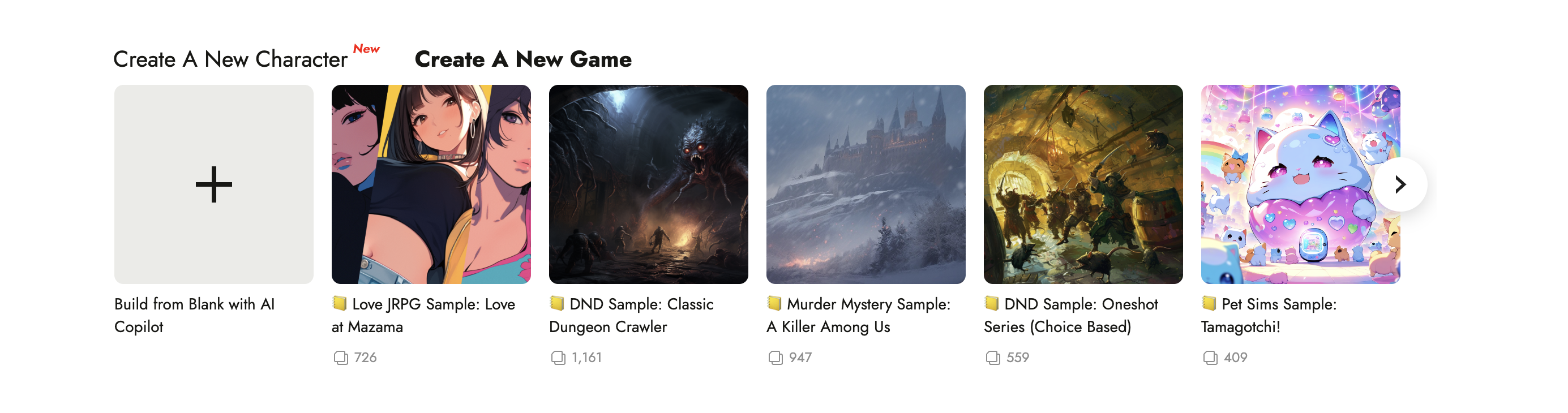
When creating a new game, you can use existing official templates or start entirely from scratch (left below). Don't worry—we'll guide you step-by-step through the process of making a game in the upcoming chapters.&#x20;

<figure><img src="https://3020543644-files.gitbook.io/~/files/v0/b/gitbook-x-prod.appspot.com/o/spaces%2FxHPTCj40SPTeJlK2vEDU%2Fuploads%2FVw6hGV29eX0KAs8asTr3%2Fimage.png?alt=media&#x26;token=158f658d-5a7b-4267-a777-28af7046a1a7" alt=""><figcaption><p>We provided official templates for a variety of game genres for you to understand what you can write in each field</p></figcaption></figure>

## Section 1. Worldview (AI Copilot Enabled) <a href="#e3f4" id="e3f4"></a>

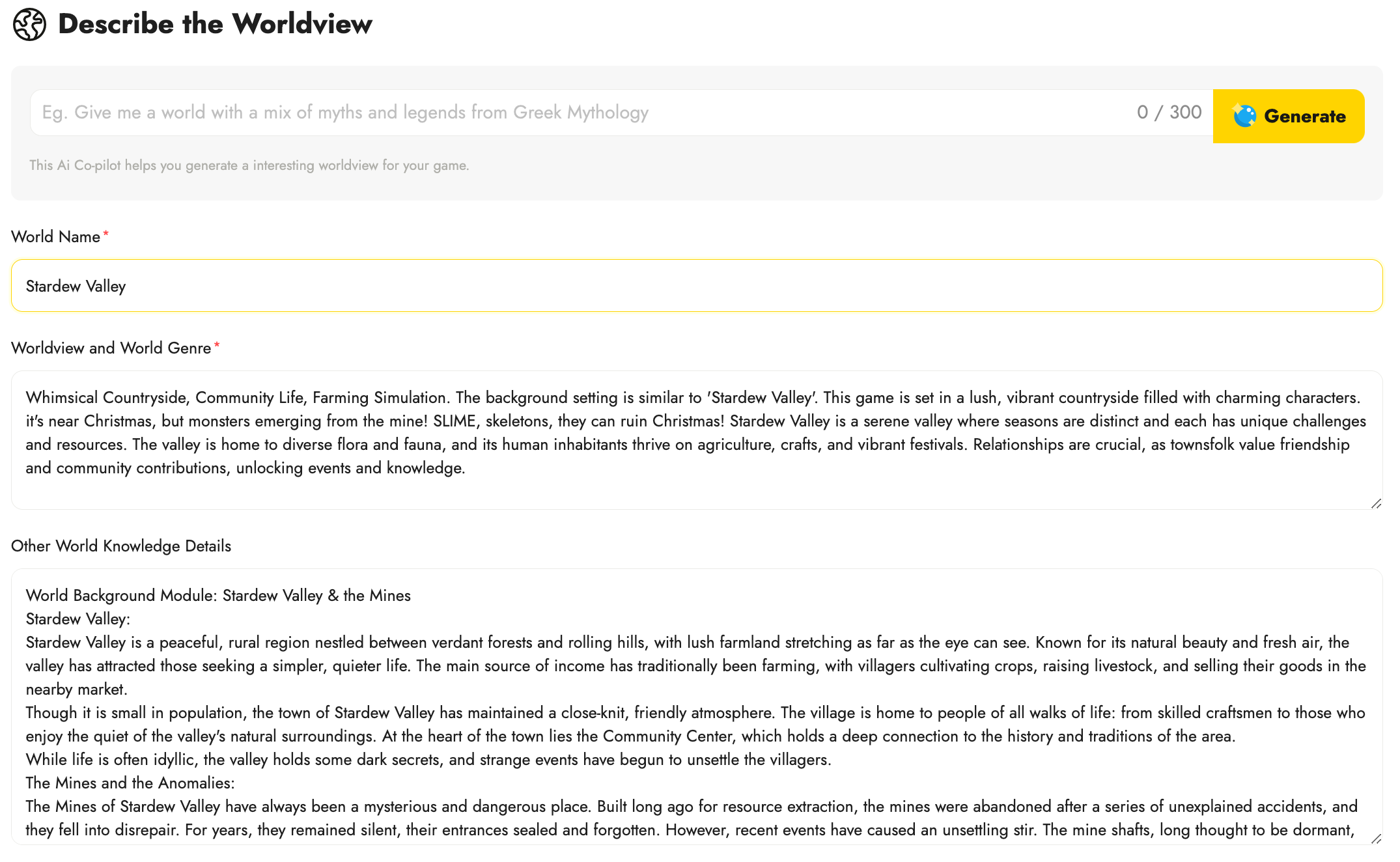
> Provide the basic settings for the created world: world name, worldview and world genre, worldview from existing works as reference and other world knowledge details.

<figure><img src="https://3020543644-files.gitbook.io/~/files/v0/b/gitbook-x-prod.appspot.com/o/spaces%2FxHPTCj40SPTeJlK2vEDU%2Fuploads%2FHSdDS0bj1b1ztUbXqmRn%2Fimage.png?alt=media&#x26;token=70b3a74b-13b9-4cc0-b393-eea7ed215bae" alt=""><figcaption><p>Sample of Worldview Design for Stardew Valley Game in Template</p></figcaption></figure>

**Worldview** represents the world in which your story resides. You can design any worldview for your game (somethings it might conflict with your character setting, but make a try) early or later. Worldview data will be given to NPCs, and if you make something conflict and fun, you can see how  NPCs adapt to the different circumstances, whether it's a cyberpunk city, a steampunk realm, or a magical fantasy world.&#x20;

* If your original worldview is intricate and detailed, feel free to elaborate as much as needed.&#x20;
* For simplicity, you can use a more straightforward reference like "Game of Thrones" and leave other places blank. The AI can understand what you want as well.

| Field                             | Meaning                                                                                                                                                                                                                                                                                                                     |
| --------------------------------- | --------------------------------------------------------------------------------------------------------------------------------------------------------------------------------------------------------------------------------------------------------------------------------------------------------------------------- |
| **World Name**                    | Genesis Moment🌟, name your world                                                                                                                                                                                                                                                                                           |
| **Worldview and World Genre**     | You can set the story **type**. If you want to create a murder mystery 🕵️, you can choose keywords such as “crime”,”detective”. You can also set the **era in which the story takes place** here. Set the worldviews that can serve as references, such as 🔍 , Sherlock, Holmes, for a quick match with knowledge in LLM. |
| **Other World Knowledge Details** | Of course, you can continue to supplement other details about the world, such as the level of technological advancement                                                                                                                                                                                                     |

## &#x20;Section 2. Design Part - Character (AI Copilot Enabled) <a href="#aa75" id="aa75"></a>

> *🦄 Outstanding character design can attract more people to play your game\~ Involve the characters in the chapters. Let’s take a look together at the **details of character settings**:*

1. Matching **avatar, name, pronouns, age, personal appearance, and background story** that align with the character design.
   1. in these fields, we recommend you to write <mark style="color:purple;">**general settings of the character**</mark>, and do not integrate the information of current scenes and how the AI will act with the player in the later plots or any plot details
   2. You might want to add the detail for plot of characters in <mark style="color:purple;">**Chapter Lore details**</mark> sections (see details in Section 4), and we've prepared a part called <mark style="color:purple;">**recent on-going for you to add the latest scene**</mark> (which is just the event right before your character met with the player) in the Chapter part.&#x20;
2. In **Personality Traits:** describe the character’s traits; Set the **tone** for how the character speaks in the Tone section.

   1. These are the most important parts in character design, which significantly affects the communication style and response format of the character.&#x20;

   > For example, you can request the AI to "speak in 50 words" at here; or "respond in three sections, including narratively explaining the current situation, your response as dialogue and four options for me to choose from"
   >
   > Here is the sample of the output from this game:&#x20;
3. **Optionally use yes/no in Add Emojis in Response & Add Actions and Gestures in Response** to control the final conversation effect.

## Section 3. Game (AI Copilot Enabled) <a href="#id-6f83" id="id-6f83"></a>

1. **Game name**, **Game intro**, and the **Game poster** on the right collectively determine the initial display interface of your game.
2. **Gameplay Mechanics:** Select the appropriate gameplay for your game, this might intervene your game flow while users are playing
3. Select the **Tags** you want to add to your game
4. Setup the **mode of Reply and mode of Memory** for your game.

## Section 4. Chapter (AI Copilot Enabled)

1. **Add chapter** In the **Chapter background**, tell the players the background of your story: when, where, who, and what happened. This is also the first piece of text that players see when they enter the game.
2. **Chapter goal** is the crucial command for completing the game.&#x20;
   1. Input your logic design with natural language in the **Goal & Condition** and Fail condition, and click generate details to generate the goal into numerical logics and task list.
   2. When all tasks are completed (which is determined by the General Game Controller AI), the game will proceed to the next Chapter
3. Add characters as **participants** for those who you want the player to interact with in this chapter
4. **Lore list:** The list which characters **are aware of** the information in the **current** chapter. For example, the timeline of a murder mystery game or the crucial checkpoints in a Dungeons & Dragons adventure. <mark style="color:blue;">See more details about how to write powerful lore in</mark> [topic-2-write-powerful-lores](https://developer.rpggo.ai/rpggo-creator-tutorial/creator-tutorial/build-game/topic-2-write-powerful-lores "mention")
5. **Endings:** This is the closing statement of the game after the player successfully completes it. Feel free to showcase your personal will!🪐
6. **Recent Ongoing of This Character**: describe the character’s recent situation in the chapters they are involved in. What was the character doing before meeting the player?
7. **Personal Secret/Flaw**:❗️If you want to arrange things that only the character knows or things that can only be revealed under pressure, you can describe them here.
8. Finally, set the starting point for the character’s emotions! Fill in the **Current Emotion**.

## Section 5. Test and Play 🎮 <a href="#a862" id="a862"></a>

Click on the\[**Play Now]**&#x62;utton in the upper right corner to embark on your exclusive **web** adventure.

**The popped-up game page link** can be directly shared with your friends, allowing them to experience the game crafted by your genius creativity! 💯

* &#x20;**\[Auto Save]** can have impact on characters immediately (😉), so feel free to experiment while playing and have dynamic view of character design effects. 💓
* In the right side bar, the **Terminal** will be the best place to chat while editing.